We had already tried to go to Peru a few times. Around 2000 it turned out to be much more expensive than other destinations, and around 2010 we got an offer, which stated that we would have to take a night bus a few times. Also not an option, but now Piet found someone at the holiday fair who could put something together for us. It became a tour through northern Peru, while everyone goes to the south.
The climate is very different, on the coast it is desert, because there is a cold Gulf Stream, which makes it misty now and then and rains every now and then. There is a difference between summer and winter here.
In the Andes it differs from place to place, very dry areas and also wetter places. Not really summer and winter, but dry and wet season. Finally the Amazon area, where it is always warm and wet.
Our journey goes through all 3 parts of the country. First coast, then Andes, back to the coast, back into the Andes, and finally to the Amazon area. From there back to Lima and then back to the Netherlands.
Monday, January 13, 2020, Lima .
We left on time with KLM to Lima, and then we had to spend 12 hours and a quarter in the air. We arrived at 7:00 Peru time, a quarter before the official arrival. Because passport control and customs went quickly, we were at the exit quickly and our guide Samantha was not there yet. She was still on her way, but arrived a quarter of an hour later.
It was much warmer than we expected. Of course, the hotel was another hour’s drive in the wrong direction, but when we got there we could still get a beer and then went to sleep at 10:00.
Tuesday, January 14, 2020, Caral .
– Travel time Lima – Caral = approx. 3 hours.
We slept reasonably well and got up at 6:30. We skipped the eggs for breakfast, they come often enough. We packed our luggage differently and then waited until 10 o’clock, because that was what we had agreed with Samantha . She will be our guide for the coming period. She will only return to Lima when we go to the Amazon.
The 10 o’clock was necessary, because she is not allowed to drive on a number of roads in Lima between 7 and 10. We left at just after 10, and Piet needed a shaver. He had forgotten it. Then we continued out of Lima. The traffic is a disaster. Piet could not find his phone, and it turned out to be still in the hotel. He can have it again on the last night in Peru, because we will be in the same hotel. After
a stretch of Pan American we came to a bad road, which we had to follow for an hour and then we ended up at a luxury tent, the Empedrada Lodge. We were treated with all the respect, since we are the first tourists of Tura-Travel. They have big plans, but with the bad road to get there, it will not amount to much.
Luxurious, but strange. All the paintings are hanging crooked, we have a jacuzzi in the room, which we can not get into, the bathroom has slippery tiles and the shower is almost impossible to get on.
Wednesday January 15, 2020, Huarmey .
In the morning you will drive with your driver to Caral.
During our excursion we will see the zone known as Sacred Fire, a little temple in which is a fireplace where found remains of coal, bones, seeds and quartz. Later on we will see one of the most outstanding buildings of Caral known as the amphitheater, where lies a circular plaza with ceremonial features, where archaeologist believes the men of Caral carried out religious ceremonies. Later on we will reach the Greater Pyramid, a strikingly large building located in a dominating position within the urban plan of Caral. It is said that officials standing on the highest part of this pyramid could monitor not only the activities going on the city, but also a large part of the capital area in the middle valley. At the site was found the corpse of a young man who was probably sacrificed in honor to local gods. Archaeologist also discovered walls decorated with small figures and collars made of shark teeth. It is believed that the Great Pyramid was the most impressive public building and also was the center of the political, administrative and religious power. From one side of the pyramid our visitors will be able to make out the green Valley of Caral that lies just behind the pyramid.
When I woke up, they said there had been an earthquake that night. Piet had been shaking in his bed, but I didn’t notice anything.
After breakfast we took a walk around the farm that belongs to the lodge. We didn’t expect much, but it turned out to be fine, although they have wild plans, which won’t come to anything. Then to Caral, with ruins that are 5000 years old. It wasn’t easy to find the entrance, but eventually we managed. It was hot and there was no shade, luckily there was wind, which made it bearable. The buildings look very similar to what we have seen so far, pyramid-like buildings, usually with a staircase at the front.
Then to our next destination, which is an eco-lodge on the coast, and we were there at about 4 o’clock. There is a kind of village on the coast with only restaurants and hotels. On the way we ate pollo a la braza. That is one of the national dishes.
The lodge is simple, and a good place for a stopover on the way to the next destination. The food was reasonable, and of course we ate fish on the coast. It is an eco-lodge, and that meant that they only have electricity for part of the day, we did not discover much more.
Thursday, January 16, 2020, Huaraz .
Today you will drive with your driver from Huarmey to Huaraz.
– Travel time Huarmey – Huaraz = approx. 4 hours.
Unfortunately no hot water and no electricity, so cold showers and no shaving. Breakfast was at 8 o’clock. It was very inefficient, but we still had a reasonable breakfast, and then we left for the next destination. We drove back a bit over the Pan American, and then turned left into the mountains. The road was good and there was little traffic. That made it go up smoothly.
Eventually the pass was at 4200 meters, and a little later we stopped at 4100 meters altitude and there we ate a sandwich and drank coca tea. Coca is said to help you get used to the altitude, but it didn’t help us that much. We didn’t feel very comfortable at that altitude, and didn’t stay there for too long. So we went down again, to the city of Huaraz. That is still 3100 meters, but we are less bothered by the altitude there.
We arrived at our hotel, and checked in. We got the key and there were no towels in the room, we asked for them and then it turned out that we were in the wrong hotel. There is a hotel Tumi 1 and a Tumi 2. We moved and now we are in Tumi 1, a newer and hopefully better hotel.
Friday, January 17, 2020, Huaraz .
Today you have a free day in Huaraz.
We didn’t sleep very well, difficulty breathing at this altitude. The breakfast was bad. Only egg and jam as a topping and bad toast and coffee, which was actually barely drinkable.
Then we went into town. It looks like all other cities in Central and South America. A few squares and a lot of traffic. On the way back we had coffee, and I had a piece of chocolate cake with it. That turned out to be a whole meal,
Then by car a bit up to a view point, where we could see the city and the mountains around us.
In the afternoon we didn’t do much. Worked a bit on the computer and prepared ourselves for tomorrow. Wait and see how it goes with exertion at high altitude. We wanted to eat in a local restaurant, but it was closed. Then we walked a bit, didn’t come across anything, and finally ate at a Chinese restaurant. It wasn’t good, but we have a full stomach again. When we walked back to the hotel we saw at least 4 better places to eat.
Saturday, January 18, 2020, Huaraz .
Today you will make a first day excursion in the area of Huaraz. You will visit the valley Callejon de Huaylas and then go to the National Park of Huascarán where you will also see the peaks of the mountain of the same name. This mountain, the Huascarán, is the highest mountain in Peru with 6768 meters. Finally, you will visit the lake of Chinacocha where it is possible to take a boat trip.
Breakfast was just as bad as yesterday, but we bravely got through it. At 8 o’clock our guide David arrived and we left for our excursion. First an hour on the asphalt road and then an hour and a half up on a bad dirt road. There we stopped at a place where there were a lot of plants. We were at about 3500 meters altitude, and there were a few lakes, which are located between the various parts of the river.
A bit on the way back we stopped at the first lake and walked. On the flat it was okay, but as soon as we had to go up it became a struggle. Still a beautiful area. Further down we had lunch, and there the advantage of leaving early became apparent. We were the first and a little later a few buses arrived, and the passengers also wanted to eat, and suddenly it was very busy. We ate trout, and that was a hearty meal.
We finished eating at 3 o’clock, and when we got back to Huaraz, we were no longer hungry. We only ate a few crackers in the evening, that was enough.
Sunday, January 19, 2020, Huaraz .
Today you will make a second day excursion in the area of Huaraz. You will visit the mountain top Nevado de Pastoruri. It is possible to reach this mountain top with a height of 5240 meters by foot or on horseback. The mountain top is located in the south of the Huascarán National Park.
We slept well last night. At 8 o’clock we left for the south, where we turned into the mountains. At the entrance of the national park we bought souvenirs. Then we stopped at a spring, where the water bubbles out of the ground.
Then on to the giant bromeliads. They grow to be 100 years old and 6 meters high. Really very impressive. Then to the glacier. That was at an altitude of 4750 meters. David wanted to take us further up, but that was too much for us. Just walking around there was tiring enough.
Back at the hotel we wanted to eat somewhere, but everything is closed on Sundays. It seems that everyone goes out with the family in the afternoon and then stays at home in the evening. So we were forced to eat at the hotel.
Despite the fact that it is the rainy season, we have hardly had anything. Only a few drops high up in the mountains and a few snowflakes at the glacier, that’s all so far.
Monday, January 20, 2020, Chimbote
Today you will drive with your driver from Huaraz to Chimbote.
– Travel time Huaraz – Chimbote = approx. 3 hours.
I went to bed at 10 and woke up at a quarter to 8, so I’ve caught up on sleep now. Quickly in the shower, get dressed, the same terrible breakfast as the other days, and at 9 o’clock we set off.
We had to cross the Andes back to the coast, so first we climbed to 4200 m and then a very long descent down. Of course it was a lot warmer there. Again through the desert on the coast, and then we had to go another 50 km north.
It’s a lot warmer here than in the mountains, it must be around 30 degrees, but it’s bearable. We stayed in the hotel and had something to drink and eat there. And then went to bed at about 10 o’clock.
Tuesday January 21, 2020, Huanchaco .
Today you will drive with your driver from Chimbote via Trujillo to Huanchaco.
– Travel time Chimbote – Huanchaco = approx. 2 hours.
The sun was shining directly on our room, and since we have a glass wall, it quickly became warm. The breakfast was fine, finally decent coffee again, good bread and reasonable toppings.
We left at 9 am, and it took at least 45 minutes before we were out of the city. Then a stretch of highway, and then that turned into a 2-lane road straight through a town/village, etc, etc. There are also speed bumps every now and then, even on a “highway”. And not speed bumps as we know them, where you can go over at a reasonable speed, but really nasty ones, where you almost come to a standstill. The area is still desert-like, like the entire coastal strip, so still not much rain to be expected.
We are now on the coast in a seaside resort, where the average guest is about 25 years old, and we have difficulty finding places where we feel at home. On the way we got the impression that the sewer of Trujillo ended in the sea a kilometer from our hotel, so going into the sea does not seem a wise idea.
The coastal strip of Peru has summer and winter, depending on the position of the sun. It is now summer (southern hemisphere), and the further north we go, the warmer it gets.
Wednesday January 22, 2020, Huanchaco .
Today you will visit the following sites around the city of Trujillo: Chan Chan, Huaca del Sol, Huaca de la Luna, Huaca de Arcoiris and Huanchaco.
– Chan Chan is the former capital of the Chimu Empire. The city was built around 850 AD and was at that time the largest city on the entire South American continent. The city, made entirely of adobe, had an area of approximately 20 square kilometers and during its heyday probably had more than 100,000 inhabitants. The city consisted of squares, houses, warehouses, workshops, streets and pyramid-shaped temples. The enormous walls of the city are painted with geometric and mythical figures, among other things. Since 1986 the city has been on the UNESCO World Heritage List, but as an endangered heritage. There is also a museum on the site.
– Huaca del Sol (the sun temple) is the largest building in Peru from the time before the arrival of the Spanish. The temple, made of adobe, was built around 450 AD and dates from the heyday of the Moche culture in this area.
– Huaca de la Luna (the moon temple) is the smaller of the two Huacas. However, the complex of the moon temple is more interesting to many because the Spanish, in contrast to the sun temple, left it more intact. On a number of walls you can still clearly see beautiful paintings in different colours. Huaca del Sol had a military and administrative function and Huaca de la Luna a ceremonial and religious function.
– Huaca de Arcoiris (the temple of the rainbow) dates from the time of the Chimu culture (900 AD). This temple, also known locally as the ‘temple of the dragon’, was only discovered in 1960. The temple is still well intact because it was covered under a layer of sand until then. It is possible to walk to the top of the temple from where you have a beautiful view. There is a small museum at the complex.
– The picturesque seaside resort of Huanchaco is located a short half hour drive from the city of Trujillo. The village is known for its beautiful beaches and good surfing waves. For fishing, local fishermen still use reed boats (tortoras). It is possible to take a dip in the sea here.
We slept well again, and the breakfast was good. Only the coffee was hot water again and coffee extract added to it, hardly to drink. Then we picked up the guide in Trujillo, and then to the first place, the Moche temple. Very big, and actually 7 temples on top of each other.
Then to a storage place of Chan-chan. In the middle of the city, but well preserved. When that was seen we went for lunch in a chic restaurant, not at all our taste, but the guide had thought of that.
Finally to the big palace of Chan-chan, an impressive building. The circumference of the walls is about 1,500 m.
Fortunately it was quite cloudy, so the heat was still a bit bearable, but when we were back at the hotel, a shower was nice. Our laundry also turned out to be done, so we can cope for a while.
Thursday January 23, 2020, Huanchaco .
Today you have a free day in Huanchaco.
The day started cloudy, so it wasn’t too warm, but later the sun came out and we were happy with the air conditioning in the room.
In the morning we went to Trujillo. Yesterday I had seen the big square and it looked beautiful. So we went there today. There are indeed beautiful buildings, and the square is one of the most beautiful we have seen in Latin America.
Here too the traffic is a mess. The most striking are the motorcycle taxis, a motorcycle with a cart attached to it, which can possibly seat 3 people. Everything drives criss-cross through each other, and it is very normal to drive in the left lane if you want to turn right.
In the afternoon we stayed in the room for a while and took it easy. Because we only had a sandwich for lunch, we could eat well again in the evening.
Friday, January 24, 2020, Chiclayo .
Today you will drive with your driver from Huanchaco to Chiclayo.
– Travel time Huanchaco – Chicalayo = approx. 4 hours.
We could have breakfast and the lady of the breakfast was less cheerful than before. She had to start an hour earlier, and as a punishment we didn’t get any fruit. At half past seven we were on our way. We made good progress, and halfway we stopped at a petrol station, They had coffee there! We were looking forward to a cup of real coffee, but it was the same as in the hotel.
We drove around Chiclayo, and that turned out to be a public rubbish dump. Unbelievable what a mess. That is noticeable in the whole country, rubbish and dirt everywhere.
We arrived at our hotel around half past twelve, which is not in the city itself, but about 25 kilometres further north, and where the buildings seem to be made of adobe, we have a large room and a very large bathroom, and mosquito nets everywhere, because it is swarming with mosquitoes here. We have already done part of tomorrow’s programme.
We went to the dry forest, There hardly falls any rain, but underground rivers provide the water. We climbed one of the pyramids, not very high, but from the top you can see a number of others.
The area here is absolutely not touristy. The few tourists come for the archaeological things, the pyramids and such, so you don’t see any souvenir shops, internet cafes, but also no cash machines, so we have to go to the big city tomorrow, since they can be found there.
Tonight the lady of the hotel made a simple meal for us. It was a bowl of soup and then a whole plate of chicken, potatoes and vegetables. Ate too much again!
Saturday, January 25, 2020, Chiclayo .
Today you will visit Tucumé and Bosque de Pomac. From one of the viewpoints you have a magnificent view of this complex with walls, squares and a total of 28 pyramids. No major finds have been made on this site, but a visit to the complex as a whole is more than worth it. Next to the site is a small, interesting museum. You will also visit Bosque de Pomac. More than 30 kilometers from the city of Chiclayo are the beautiful ruins of Batán Grande. This is an important archaeological site with 50 pyramids and various graves. The ruins date from the Sican period (900 – 1100 AD). Next to these ruins is a large forest with locust trees.
We had breakfast and then the guide arrived. First to the museum nearby. That was very nice. They try to recreate the environment outside in the garden that was there when the pyramids were in full operation here. That is to say no rice fields, no sugar cane, but mainly dry tropical forest and fields where they grew vegetables etc.
Then a second museum, which I didn’t think much of, and then we went to a larger city, where we could withdraw soles. That will keep us going for a while. Then we had lunch in another overly luxurious restaurant. We couldn’t get a beer there, because there are elections tomorrow. Then the whole country will be dry, just like in Venezuela.
The guide knew someone in Chiclayo, who could arrange a bottle for us, and we did. When that was done, we drove on to the last archaeological site. Here is a pyramid, where they have exposed the burial chambers and filled them with (copies of) objects that they found there. That was interesting.
We had said after 2 museums that we didn’t want to visit a third one, but in hindsight that may not have been so smart, since the museum contains the Lord of Sipan, and that must be very beautiful.
Then back to the hotel, and there we could just get a beer. So the ban on alcohol isn’t that strict.
Sunday, January 26, 2020, Chiclayo.
Today you will visit perhaps the most beautiful museum in Peru: Tumbas Reales de Sipan, with the Lord of Sipan as its showpiece. In the museum you will see an extensive collection of gold and silver objects, ceramics and textiles that members of the pre-Inca Moche culture designed. Many of these objects were found in the tomb of one of their great leaders el Señor de Sipán, a tomb that was excavated in the late 1980s. Two articles about the excavation of this tomb were published in National Geographic magazine in 1988 and 1990.
We already did the above yesterday, and now have a quiet day, since we have to drive a long way tomorrow. Breakfast at 8 o’clock and furthermore only agreed that we would eat in the hotel in the evening.
We looked around in the garden a bit, but it remains a dry place. Around 12 o’clock we went to the restaurant nearby to eat. There were an awful lot of motorcycle taxis on the road. We heard later that this had to do with the elections. They make sure that alcohol is not allowed to be served anywhere, but in our restaurant they had not heard of that or they didn’t care.
We ate here in the evening and the mosquitoes are getting more and more brazen. They don’t care much about Piet’s deet anymore.
Monday, January 27, 2020, Cajamarca.
Today you will drive with your driver from Chiclayo to Cajamarca.
– Travel time Chiclayo – Cajamarca = approx. 6 hours.
Samantha had no confidence in her driving skills, so we got a driver. In hindsight, she could have done it herself. But after a last breakfast and a few more mosquito bites, we left.
We drove back for over 2 hours on the road we came on a few days ago, and then turned left into the mountains. The road was good, although they were renewing the bridges in a few places. The pass was at 3100 meters and we are now at 2600 meters, a bit of a struggle again.
We are staying in a hotel in the middle of the center, and went into town for a while. And then it started to rain, so we fled into a cafe. After 10 minutes it was dry again, and then we could go back to the hotel.
In the evening we ate in the same tent as where we were this afternoon. We did try to find something else, but that didn’t work. Apparently we walked the wrong way.
Tuesday, January 28, 2020, Cajamarca.
In the morning you will make an excursion to the pre-Inca aqueduct Cumbemayo. The aqueduct dates from the 15th century BC and is considered one of the oldest constructions in the South American continent. On the aqueduct and the surrounding rocks you can admire a large number of rock carvings. The surroundings are beautiful and we will take a nice walk here. The remote region is also called ‘the stone forest’ because of the natural, volcanic rocks that have been formed by erosion over time so that they look like trees. In the afternoon you are free in Cajamarca.
We left with another guide at 8:30. That is at least an hour earlier than all the other tourist buses and vans. Because of that we missed the big crowds. Because at the end of the trip we saw at least 5 minibuses and a larger bus.
We had to walk 20 km on a bad dirt road to get to 3500 meters. From there we took a walk. First to a sacred rock complex, and then descending to an aqueduct or better a canal, carved out of the rocks, and constructed about 3000 years ago.
The walking went reasonably well, even though we were at 3500 meters altitude. Samantha walked ahead for the last part to pick up the car, and when we were 5 minutes at the end point she arrived. Then another 20 km down.
It did not rain today either, even though this is the rainy season in the Andes. The last two weeks we only had a shower yesterday, that is actually nothing.
When we got back we just had a quick meal at the hotel, and then we walked to the big square. On the way we got some soles out of the ATM, because we won’t be coming across a bigger place the next few days, and a lot of credit cards won’t be used either. We took some more pictures on the square, and then we had had enough.
Wednesday, January 29, 2020, Leymebamba.
Today you will drive with your driver from Cajamarca to Leymebamba. Many hanging tombs have been discovered around the village of Leymebamba in the past decades. The pre-Inca people ‘the Chachapoyas’ buried their ancestors in this way. In the afternoon it is possible to visit the museum of Leymebamba yourself, which has an informative exhibition about the tombs and where many mummies can be viewed. The magazine National Geopraphic has financed expeditions to the hanging tombs and devoted several articles to this. Many hanging tombs are still well intact because their location makes it difficult for grave robbers to reach them. If desired, you have time in the afternoon to visit the above.
– Travel time Cajamarca – Leymebamba = approx. 5 hours.
The 5 hours of the description were completely wrong. We left at 8 o’clock, and the distance was 250 km. The first 100 was on a good road, although with only bends and rarely a straight stretch, but that went reasonably well.
But then it became a road of about one and a half cars and only bends and ups and downs. We went to 3500m, then back to 800, and then we were in a village, where we had dinner.
Then again to 3600 m and then to 2200, where our hotel is. Part of the trip we were in the clouds, and on the last mountain it also started to rain. Finally we arrived at our hotel at a quarter to 5.
The hotel is very simple, but we have a bed, a toilet and wifi. Later we had dinner on the square in a chicken restaurant.
Thursday January 30, 2020, Chachapoyas.
Today you will be taken to your hotel near Chachapoyas. On the way you will visit the hanging tombs of Revash, near the town of Santo Tómas. In the museum in Leimebamba you have already read and seen a lot about these tombs, here you can see them in real life. The hanging tombs look like houses and they hang on the ledges of high cliffs in the landscape.
– Travel time Leymebamba – Gocta = approx. 3 hours.
We had a nice breakfast with the grandmother of the hotel. Finally a decent coffee. Then to the museum, where they have a beautiful garden. The lady who is responsible for the garden, now got a visit from someone who also knows a bit about it, and that led to a nice tour in the garden with only plants that grow in the area.
Then back to Leymebamba, where we picked up the guide, and then to Revash. First a stretch on the asphalt road, and then off the road and up and down a dirt road. Finally, after about 16 km we arrived in Revash. From there it was another hour’s walk and then we had a view of the rocks where the tombs were.
We could have walked further, but that was too much to ask. We took pictures and walked back. I am starting to get into the rhythm, because I could walk up to an altitude of about 2800 meters without getting out of breath.
Then back on the dirt road, and then another hour on the asphalt road, and finally another 5 km of dirt road. We are now in a luxury lodge, called Gocta lodge, and that is about 30 km from the city. There is a small village nearby, where they also have a few restaurants, so we don’t have to eat in the lodge all the time.
Friday, January 31, 2020, Chachapoyas.
Today you will visit perhaps the highlight of the trip, namely the largest stone structure in South America, the Kuelap. This magnificent pre-Inca structure is also called the Machu Picchu of Northern Peru. This fortress, only rediscovered in 1843, dates from the 10th and 11th centuries and consists of more stones than the largest pyramid in Egypt. The colossal structure is located in a beautiful, green environment and only a few Western tourists have been here. Under the guidance of an English-speaking, local guide, you will visit the impressive structure.
Breakfast was good, and we left for Kuelap at 8 am. Halfway we picked up our guide Roger, and then we drove on. At the bottom of the road to Kuelap there was a sign saying 37 km. So I expected to have to bounce along a bad road for at least two hours, but that turned out very differently.
After a few kilometers we stopped at the starting station of a cable car. However, there was no cabin to be seen. I didn’t understand it, but then it turned out that we had to take a bus for another 4 kilometers, and there we could take the cable car. 20 minutes and then we were at the end of the road, which they used to have to drive.
Then a half hour walk up and then we saw Kuelap. Very big, and there was a route through the complex, which we followed. Very interesting, and there was some mist, but that stayed on the side of the mountain. At a certain moment it started to rain for a while, but we could take shelter somewhere and a few minutes later it was dry again.
The complex looks different from the previous places. No pyramids, but ordinary stone buildings and round houses. It is located at a high altitude, and that is for religious reasons. People were closer to the sun, moon and stars. The fact that all food and drink had to come from the valley was no problem.
Then back down again, and then we wanted to take the cable car back down, but that was not possible. Stones had fallen on the road, and the bus could not drive. Luckily that only lasted 10 minutes, and then we could go back down. Then it started to rain seriously.
Down we got in the car and drove to the first village with a restaurant. Roger’s mother and sister work on the mountain, and his uncle had the restaurant where we had a nice meal.
When we got back to the hotel, I got a message that my mother’s house had been sold. Glad that it happened so quickly, no hassle with endless viewings and such.
Saturday, February 1, 2020, Chachapoyas.
You will take a walk to the Gocta waterfall, also known locally as la Chorrera. This 771 meter high waterfall is considered the third highest waterfall in the world. Due to the difference in height and the bad path, the walk to this spectacular waterfall is a bit difficult. The walk to the Gocta waterfall starts next to the hotel where you will spend the night.
We are now on the eastern side of the Andes, and the climate here is different from that on the coast. They also speak of summer and winter, but they actually mean something else. Winter is the rainy season, from about December to April, and then it is probably a few degrees cooler than in the dry season. Despite the winter, we have hardly had any rain, actually only yesterday in the cable car.
We walked a part of the easy path to the waterfall. That was already difficult enough for us. After a little over an hour we turned around and were back around 11 o’clock. That was nicely in time, because it started to rain at 12 o’clock.
On the way we met many people who also wanted to follow the path. Quite a few people on horseback, and none of them looked very happy. Most of them did not look like they could complete the entire 5-hour hike.
It rained for a good part of the afternoon, and now we can see several small waterfalls. The road was also quite wet, and when we walked to a restaurant, we should have taken our flashlights with us. It was another local place, but the food was good and not too expensive. Of course, prices do rise when it is a touristic place like where we are now.
In the evening we wanted to eat in the village, and then we discovered that the street was full of puddles and muddy. Fortunately, the street lights worked, so we could walk to a restaurant and back without getting wet feet.
Sunday, February 2, 2020, Chachapoyas.
Free day in Gocta.
The morning started misty, although it wasn’t raining. I’m starting to get tired of breakfast. Eggs, cheese that tastes like nothing, jam that’s way too sweet and bad coffee. Another week and then we can eat normally again.
On this rest day we drove back over the road to take pictures. On the other days we didn’t get around to that. The problem is that you can’t stop everywhere, so that was a bit of a puzzle. Then we drove to Chachapoyas, in the pouring rain. When we got there it was almost dry again. We ate and then went back to the lodge.
And there it started to rain again. But by then we were already inside, and it didn’t bother us much. So we’re lucky with the weather again, and our health is also not bad.
Monday, February 3, 2020, Jaen.
Today you will drive with your driver from Gocta to Jaen.
– Travel time Gocta – Jaen = approx. 3 hours.
At half past eight we left our hotel. The road was mainly downhill, and after about 3.5 hours we arrived at our new hotel. It is a super-deluxe affair, not quite what we would like. We prefer a slightly older hotel, as long as it is clean.
We are now at about 700 m altitude and it is immediately a lot warmer. We thought we were heading towards the Amazon and therefore also towards a more humid climate, but that is not the case. It is still desert-like.
In the afternoon we went to the Botanical Garden. That was a disappointment, nothing original. Then we went to the Plaza des Armas, also not great. The entire city seems to consist of motorbike sellers and everything that has to do with motorbikes. Nothing nice.
Tuesday, February 4, 2020, Cutervo.
In the morning you will drive with your driver from Jaen to the National Park of Cutervo. With a local guide you will make a first excursion in the National Park of Cutervo in the afternoon. You will spend the night in a hostal close to the National Park. NB: The exact details of what a visit to the National Park of Cutervo can look like will follow.
– Travel time Jaen – National Park of Cutervo = approx. 2 hours.
We left early for Cutervo, but it took more than 3 hours. Bad road, end in thick fog, rain, so we only arrived in Cutervo at 11 o’clock. We dropped off our stuff at the hotel, and because it was a lot colder, we adjusted our clothing accordingly.
Then another 2 hours to the national park. First we ate something there and then by car a bit up, and then by truck a bit further. The intention was that we would walk down to our own car and then drive back.
It turned out to be nothing at all. Mud, just walking through meadows, even more mud, slipping and nothing to see. Finally we were back at the car at a quarter past 5, with shoes that looked terrible. There was a stream, where the worst dirt was washed off with water and grass as a brush, and then they were wrapped in plastic, so that they wouldn’t make the rest dirty.
And then we had to go back another 2 hours. The first hour on the dirt road was just possible before it got too dark, but the second part was in the dark on a road that was one and a half cars wide.
Back at the hotel we wanted to take a shower and put on other clothes. That shower was a misery. Later we heard that you have to turn on the hot water tap for 5 minutes before hot water comes out.
This was one of the worst things we have experienced on our holidays. You may be able to do something nice at another entrance to the park, but this was a waste of the time we spent on it.
Wednesday, February 5, 2020, Jaen.
With a local guide, you will make a second excursion in the morning in the National Park of Cutervo. In the afternoon you will drive with your driver from the National Park of Cutervo back to Jaen. NB: The exact details of what a visit to the National Park of Cutervo can look like will follow.
– Travel time National Park of Cutervo – Jaen = approx. 2 hours.
We really didn’t feel like seeing more of the national park, so we decided to first look around a bit in Cutervo and then calmly go back to Jaen. The hotel didn’t have breakfast, so we ate and drank something somewhere else. We looked around a bit more, but there wasn’t much to it, so at 9:30 we set off.
The weather was much better than yesterday, and we only had to drive a short distance through the clouds.
We are back in the same hotel as before, even in the same room. The air conditioning still barely works, so it stays warm in the room. Jaen is a city with nothing to offer. You mainly see motorcycle shops and everything that has to do with coffee and/or cocoa. No cozy square that is worth a visit.
Thursday, February 6, 2020, Iquitos.
You will be transferred to Jaen airport and fly with a domestic flight from Jaen to Lima. At Lima airport someone will be waiting to take you to your hotel in Lima, Miraflores.
In the meantime, the plans have changed. We are not staying overnight in Lima, but are flying to Iquitos on the same day, and are staying overnight there. That did mean that we left our hotel at 6:30 to go to Jaen airport. When we got there, we had our papers in no time, the luggage was checked and checked in.
There we said goodbye to Samantha, who is now driving back to Lima, and we could take the bus to our plane. It left quite quickly, and an hour later we were in Lima.
There we picked up our luggage, went to the counter of Latam (the company we are flying with), and then we quickly had our boarding passes. We dropped off the luggage and asked for more legroom. We got that without paying extra. Then through security again, where even my glasses caused problems.
But anyway, when that was over we could have a late breakfast. And finally have a tasty cup of coffee.
We were in Iquitos quite quickly, where it is nice and warm, and were picked up by someone from the hotel. Twenty minutes drive, and then we were there. Hotel with air conditioning, which doesn’t provide much cooling.
We wanted to buy something to drink, so we went for a walk. Only phone shops, travel agencies and motorcycle shops. We ended up on the central square, took some pictures there and then we went back to the hotel, dejected. Close to the hotel there was suddenly a supermarket where we could buy everything we wanted.
We hope that our program change has been received by the organization, and that we will be picked up tomorrow.
Friday February 7, 2020, Heliconia River lodge.
You will be taken to Lima airport in the morning and fly with a domestic flight from Lima to Iquitos. You will be picked up from Iquitos airport and taken to the meeting point in the city. Here you will receive information about the stay in the rainforest. Then you will drive a bit by bus and sail with a speedboat to the lodge (Heliconia Amazon River Lodge). During this beautiful boat trip you will visit a small local community on the Amazon. At the lodge you will be welcomed with a lunch. In the afternoon you will start with the first excursion. Together with the guide you will take a walk in the Yanamono Reserve. The guide will show you various (medicinal) plants and large trees such as the kapok tree. During this walk there is a good chance that you will see birds such as the turkey vulture and the jacana and monkeys such as the saddle-back tamarind, the jumping monkey and the death’s-head monkey. After having experienced the sunset in the Amazon rainforest, you will sail over the river in the dark. During sunset you will hear the sounds of the jungle well. If you are lucky you will spot crocodiles and other animals in the dark. When it is a clear night you will also see countless stars.
We didn’t know when we would be picked up, so we thought it would be 9 o’clock. Downstairs in the hall Piet had the bright idea to look at the voucher and it said between half past nine and a quarter to ten.
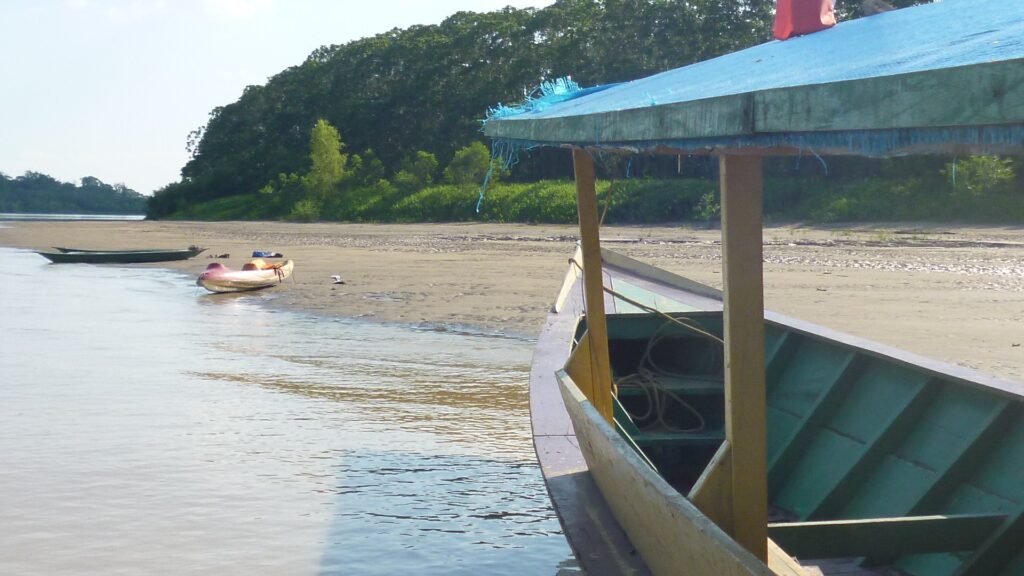
We were picked up by a van, at two other places more people arrived and then to the harbour. There was the boat and we set off. After more than half an hour we were at an island with monkeys, pets that the people had discarded and that were now being prepared to go back into the wild.
Then to the lodge. It looks good. Netting everywhere against mosquitoes, spacious room, and no telephone or internet. The temperature is high, and we are already sweating quite a bit. There is a generator and we have electricity from 5.30 to 9.00, from 12.00 to 15.00 and from 17.30 to 23.00. There is hot water all the time, although that may be a bit exaggerated.
After arrival a welcome speech and lunch. There we were already asked what we wanted to eat for dinner, a la carte!!
In the afternoon a walk through the forest. For this time we put on the lodge’s wellington boots, and that was not bad. The place was quite muddy. We saw a few things, but as usual it was very dark again, so that photos did not work out too well.
It cooled down reasonably, so that we found the temperature pleasant later in the afternoon and in the evening. We also slept well. We will do all the excursions that are in the program, but the order will probably be different, they will have a fixed order, where you fall in somewhere.
Saturday February 8, 2020, Heliconia River lodge.
You will get up early in the morning to go with the guide in search of birds such as the American giant kingfisher and the black-collared hawk. After breakfast you will sail to one of the tributaries of the Amazon and if you want you can fish for piranhas. With a bit of luck you will see pink freshwater dolphins during this boat trip. In the afternoon you will walk and sail with the guide to the island of Yanamono in the lake of the same name to see giant water lilies. In the evening you will take a walk with the guide and go in search of tarantulas, fireflies, bats and other animals that live at night.
We left at 6 o’clock by boat. First a stretch on the big river and then in a tributary. We saw quite a few birds, but it was quite dark, the birds were far away and often small, so taking pictures was almost impossible.
We are quite a distance from Iquitos, but there are still people everywhere. So there is no real untouched nature anymore. We are also close to a village of the Jagua tribe, and we went there after breakfast.
We were welcomed by a group of children, who had all kinds of animals with them, monkeys, parakeets, turtles and even a sloth. The village looked reasonable, hardly any waste, there were solar panels and street lighting.
But we had to go to a large hut, where the people in original Jagua clothing went dancing. Afterwards we could buy souvenirs at their market. It was quite a spectacle.
In the afternoon they went fishing. I don’t like that, so I stayed in the lodge. It rained quite a bit there, but the boat with the fishermen was a few kilometres away and they only had a few drops there. But we did see pink dolphins!
I was still busy with my shoes. They are a lot cleaner now, but I suspect I still have quite a job to do at home to get them completely clean again. Piet is not taking his shoes back to the Netherlands, just like a number of items of clothing, for which Samantha still knows a destination.
We are now eating lunch and dinner a la carte. That is possible when there are only so few people (there are 7 now), but when it is fuller (there are 35 cabins), that is impossible and they have a buffet.
Sunday February 9, 2020, Heliconia River lodge.
After breakfast you will sail to a local community and get an idea of how they live there. You may see freshwater dolphins during the boat trip. The afternoon is free. In consultation with the guide you decide what you are going to do.
We were with a maximum of 10 people in the lodge the whole time, and it seems that there will be even less, because the 2 Peruvians, with whom we did excursions together the whole time, leave today after lunch, and then we have Victor, our guide, to ourselves.
In the morning we sailed to the water lilies (Victoria Regina or Victoria Amazona). A bit over the big river and then through a tributary. There was a lot of floating grass and other floating plants, but at a certain moment we saw the water lilies. The leaves can grow up to 2 meters in diameter, and luckily there was one that was blooming.
Then to the distillery, where alcohol is made from sugar cane. We got to taste 4 different liqueurs, and also molasses.
In the afternoon we were the only guests for our guide, and we could decide for ourselves, what we wanted. And we felt like another boat trip to see birds and plants. We entered a tributary, and sailed a long way, until it became too shallow for the engine, and then the two Peruvians continued with the paddle. They were looking forward to it themselves, because it took more than 2.5 hours before we were back at the lodge. And we thought it was the best trip of all, what we have done here.
And again we were incredibly lucky with the weather, It looked very threatening, but it rained a little for a few minutes at most, I did not get further than untying the cord of my poncho.
Monday, February 10, 2020, Lima.
In the morning you will visit a distillery where you can see how sugar cane liquor is made. After lunch you will be taken back to the city of Iquitos by speedboat and bus. At the end of the afternoon you will fly back to Lima with a domestic flight from Iquitos. At the airport of Lima someone will be waiting to take you to your hotel in Lima, Miraflores.
We could have done another excursion, but neither of us could think of anything, and we didn’t feel like going shopping in the forest again with rubber boots on. That’s why we decided to skip activities in the morning.
Two more days and then we’ll be back in the Netherlands. We’re starting to long for it now. Another sandwich with good cheese, your own bed and your own rhythm.
We finished breakfast at 8 o’clock, and apart from lunch at half past twelve and departure at a quarter to two, nothing was set. We walked around a bit, I even visited the swimming pool, and eventually it was lunchtime.
We left at a quarter to two and at 3 o’clock we were in Iquitos. It was boiling hot and we were afraid of a very long wait at the airport without air conditioning, but we were pleasantly surprised. We were dropped off at a hotel and could stay there in the cool until 5 o’clock. Better than we could have imagined!
When we were there, a real downpour came by, but when we went on to the airport at 5 o’clock, it was dry. Only on the road were still a lot of puddles, apparently the sewage system in Iquitos is not yet fully optimal.
We left on time, and when we arrived in Lima, the driver was already waiting for us. He drove to the hotel in 45 minutes, and there Piet was reunited with his phone.
Tuesday, February 11, 2020, On the road.
A free day in Lima. If desired, we can organize an excursion for you this day. At the end of the afternoon you will be taken to the airport for the return flight of 20:00 with KLM back home.
It was very windy in the Netherlands, and a lot of flights from Schiphol were cancelled or delayed. The flight to Lima luckily left with only a fifteen minute delay, so our return flight will be able to leave according to schedule.
We walked around a little bit in the area and found a place near the hotel where we could eat something for lunch. We waited until we were picked up. At the hotel they thought we had not left the room quickly enough and they took Piet’s luggage from the room and put it downstairs.
Samantha arrived at half past four and we expected that it would take at least 2 hours before we would be at the airport, but it only took an hour and fifteen minutes. We checked in quickly, and also quickly through security and the pass.
We went to the gate, but it took a very long time before we could board the plane. Because of that we left about half an hour late, but because of the strong jet stream the flight only lasted 11.5 hours and we were still able to arrive on time.
Wednesday, February 12, 2020, Back.
We were at Schiphol at 3 o’clock, at a point that is about the furthest away from the exit and baggage belt. We had to walk a very long time before we got there. Luggage was there, back home and recovering from the jetlag.